Nowfel Insights
Texapon: Properties, Uses, Types, Price and Purchase

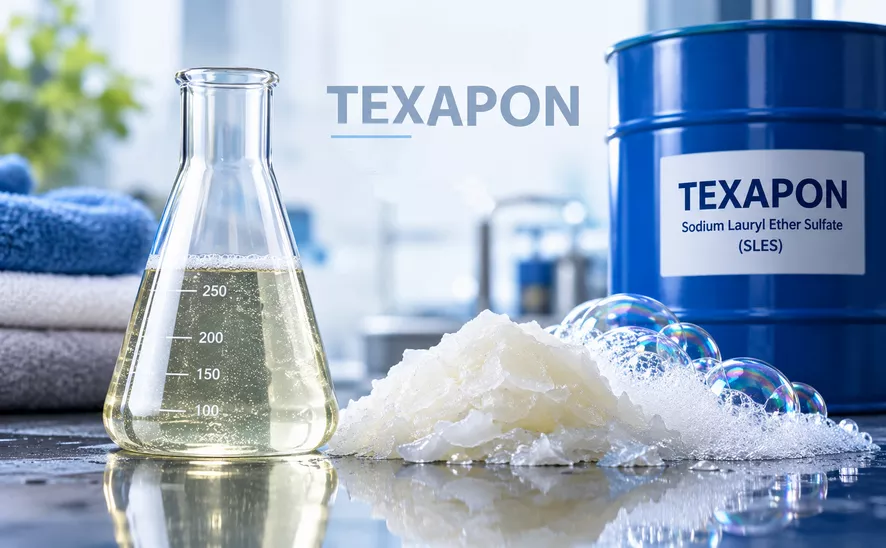
If you are familiar with the world of detergents, you have probably heard of Sodium Lauryl Ether Sulfate(SLES). This widely used surfactant has numerous applications in the detergent, personal care, and hygiene industries and is more commonly known by its trade name, Texapon. As an anionic surfactant, Texapon is valued for its effective cleansing properties, excellent foaming performance, and compatibility with a wide range of formulation ingredients.
It is therefore widely used in products such as shampoos, liquid hand soaps, shower gels, dishwashing liquids, and other liquid cleaning formulations. In this article, we will explore Texapon, its different grades, key properties, common applications, and the important factors to consider when selecting and using it.
What Is Texapon?
Texapon is a trade name used for certain grades of surfactants based on Sodium Lauryl Ether Sulfate(SLES). The term generally refers to commercial SLES products supplied in different concentrations and grades, with Texapon N70 being one of the most widely used grades. The exact properties of a Texapon product, such as active matter, concentration, appearance, and viscosity, depend on its specific grade and manufacturer.
How Does Texapon Work as a Surfactant?
Texapon works as a surfactant by reducing the surface tension between water and oils, dirt, or other substances, allowing them to be dispersed and removed more easily during washing. Its Molecular Structure contains a hydrophilic sulfate group that interacts with water and a hydrophobic alkyl chain that interacts with oils and grease, enabling Texapon to form micelles and help lift contaminants from surfaces.
These characteristics are closely related to the Chemical Properties of Texapon, including its good water solubility, strong foaming ability, detergency, and compatibility with various formulation ingredients.
| Property | Specification |
|---|---|
| Chemical Name | Sodium Lauryl Ether Sulfate (SLES) |
| Trade Name | Texapon |
| Other Names | SLES, Sodium Laureth Sulfate, Sodium Lauryl Ether Sulfate |
| Chemical Formula | C12H25(OCH2CH2)nOSO3Na |
| Chemical Type | Anionic Surfactant |
| Appearance | White to pale yellow viscous paste |
| Solubility | Highly soluble in water |
| pH | Typically around 7–9, depending on grade and concentration |
| Active Matter | Varies by grade; Texapon N70 typically contains about 70% active matter |
| Main Function | Cleansing, foaming, wetting, and emulsification |
| Main Applications | Shampoo, liquid soap, shower gel, dishwashing liquid, and detergents |
Types of Texapon
Texapon N70
Texapon N70 is a highly concentrated grade of SLES containing approximately 68–73% active matter, with a typical concentration of around 70%. It is supplied as a viscous paste and is valued for its strong cleansing performance, good foaming properties, and ability to thicken formulations with salt. Its high active matter content also makes it suitable for concentrated detergent and personal care formulations where a lower water content is preferred.
Texapon N70 is widely used as a primary surfactant in shampoos, shower gels, liquid soaps, dishwashing liquids, laundry detergents, and industrial cleaning products. Compared with lower-active SLES grades, its higher concentration allows formulators to use less raw material to achieve the desired level of surfactant activity.
Texapon N25
Texapon N25 is a liquid grade of Sodium Laureth Sulfate with an active matter content of approximately 24.5–25.5%. Compared with Texapon N70, it contains significantly more water and is therefore supplied in a ready-to-use liquid form that can be easier to handle and incorporate into formulations.
Its relatively low concentration makes Texapon N25 suitable for formulations where a liquid surfactant with a moderate active content is preferred. It is used in personal care products, detergents, liquid soaps, and other cleansing formulations, with BASF listing applications across personal care, detergents, and industrial cleaning.
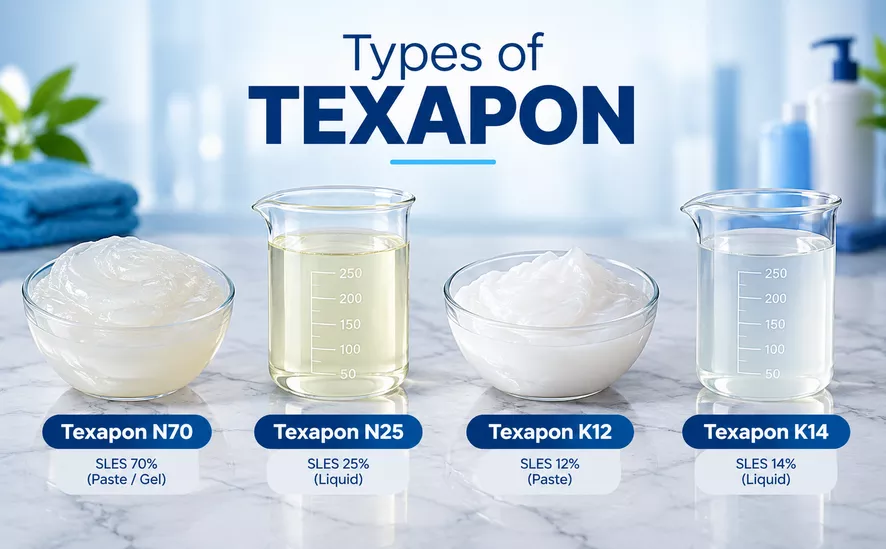
Texapon K12
Texapon K12 differs from N70 and N25 because it is based on Sodium Lauryl Sulfate rather than Sodium Laureth Sulfate. BASF offers Texapon K12 in K 12 G granules and K 12 P powder, both with an active matter content of approximately 95–99%.
Because of its high active matter and solid form, Texapon K12 is useful in applications where a concentrated powdered or granular anionic surfactant is required. It can be used in detergents, cleansing products, cosmetics, and other formulations requiring strong foaming and cleansing performance.
Texapon K14
Texapon K14 S SPEZ 70% is another Texapon grade with an active matter content of approximately 68–73%. Unlike N70, which is a Sodium Laureth Sulfate grade with 2 EO, K14 S SPEZ 70% is listed by BASF as Sodium Myreth Sulfate. It is supplied as a paste and is used primarily in personal care and cleansing formulations, including products where a high-active surfactant paste is required.
Its relatively high active content makes it suitable for concentrated formulations, while its surfactant properties provide cleansing and foaming performance. The chemical nature of K14 means it should be considered a distinct Texapon grade rather than simply another form of SLES N70.
Texapon Grades and Their Differences
Texapon grades can differ significantly in chemical composition, active matter, physical form, and typical applications. The table below provides a quick comparison so the main differences between these commonly referenced grades can be understood at a glance.
| Texapon Grade | Chemical Type | Active Matter | Physical Form | Common Applications |
|---|---|---|---|---|
| Texapon N70 | Sodium Laureth Sulfate (SLES), 2 EO | 68–73% | Paste | Shampoo, shower gel, liquid soap, dishwashing and detergents |
| Texapon N25 | Sodium Laureth Sulfate (SLES), 2 EO | 24.5–25.5% | Liquid | Personal care products, detergents and cleaning formulations |
| Texapon K12 | Sodium Lauryl Sulfate (SLS) | 95–99% | Powder / Granules | Detergents, cleansing products and cosmetic formulations |
| Texapon K14 S SPEZ 70% | Sodium Myreth Sulfate | 68–73% | Paste | Personal care and cleansing formulations |
Texapon Gel vs Powder
The terms Texapon gel and Texapon powder generally refer to different physical forms or grades of surfactant rather than representing a single chemical substance. Texapon N70, for example, is supplied as a concentrated paste and can form a characteristic gel structure when diluted with water, while Texapon K12 is available in high-active powder and granular forms.
Therefore, the physical form is an important factor when selecting Texapon because it affects handling, dissolution, processing, storage, and the way the surfactant is incorporated into a formulation.
Uses of Texapon
As you have learned throughout this article, Texapon has a wide range of applications across the detergent, personal care, and cleaning industries.
- Shampoos
- Shower gels
- Liquid hand soaps
- Body washes
- Facial cleansers
- Dishwashing liquids
- Laundry detergents
- Liquid detergents
- Household cleaners
- Industrial cleaning products
- Car wash products
- Floor cleaners
- Bathroom cleaners
- Cosmetic cleansing products
- Bubble baths
- Foam baths
- Hair conditioners
- Liquid soaps
- Personal hygiene products
- Textile cleaning formulations
Texapon in Detergent Formulations
Texapon plays an important role in detergent formulations, particularly in liquid detergents, because of its strong cleansing, foaming, and wetting properties. It helps reduce the surface tension of water and allows oils, grease, dirt, and other contaminants to be dispersed and removed more effectively. For this reason, Texapon is widely used in liquid laundry detergents, dishwashing liquids, household cleaners, and industrial cleaning products.
Texapon can also be combined with other anionic, nonionic, and amphoteric surfactants to improve the overall cleaning performance and formulation properties. When formulating with Texapon, factors such as active matter concentration, pH, viscosity, salt content, surfactant compatibility, and the desired level of foam should be carefully considered. Selecting the appropriate Texapon grade is also important, as different grades vary in concentration, physical form, and performance.
HOW TO MAKE LOCAL TEXAPON AT HOME
Ingredients
- SLS (powder) – 125g
- Sodium sulphate – 87.5g
- EDTA – 1.5g
- Water – 300ml

Procedure
- Pour 125ml of hot water into a clean bowl and add the EDTA. Stir till it dissolves.
Add sodium sulphate and stir till it dissolves. - Add the SLS powder and stir for about 4 minutes.
- Add 75ml of hot water and stir slowly for about 2 minutes. Then go ahead and stir properly for about 5 minutes.
- Cover and allow to rest for 2 hours.
- Add the remaining 100ml of hot water and stir gently for about a minute. Go ahead and stir it properly for 3 minutes.
- Cover and allow it to settle for 24 hours.
- Your local Texapon is ready.
Texapon vs Other Surfactants
Texapon differs from other commonly used surfactants mainly in its chemical structure, foaming behavior, cleansing strength, mildness, and compatibility with other ingredients. Texapon grades based on SLES generally provide a good balance between cleansing and foam, while SLS offers stronger cleansing but can be more irritating.
LABSA is a powerful anionic surfactant widely used in heavy-duty detergents, whereas CAPB is an amphoteric surfactant commonly used alongside anionic surfactants to improve mildness and foam stability. Nonionic surfactants, on the other hand, are valued for their grease-cutting performance and tolerance to hard water, making them complementary to Texapon in many detergent formulations.
| Comparison | Texapon | SLES | SLS | LABSA | CAPB | Nonionic Surfactants |
|---|---|---|---|---|---|---|
| Surfactant Type | Anionic | Anionic | Anionic | Anionic | Amphoteric | Nonionic |
| Typical Chemical Base | Usually SLES | Sodium Laureth Sulfate | Sodium Lauryl Sulfate | Linear Alkylbenzene Sulfonic Acid | Cocamidopropyl Betaine | Varies by type |
| Foaming | High | High | High | High | Good to high | Low to moderate |
| Cleansing Power | Good | Good | Strong | Very strong | Moderate | Good, especially for grease |
| Mildness | Moderate | Moderate | Lower than SLES | Low | High | Generally good |
| Main Advantage | Good balance of cleaning and foam | Effective cleansing and foaming | Strong cleansing and foam | Powerful cleaning and detergency | Mildness and foam stabilization | Excellent grease removal and hard-water tolerance |
| Common Applications | Shampoo, liquid soap, shower gel, detergents | Shampoo, personal care, detergents | Detergents, cleansers, personal care | Laundry and heavy-duty detergents | Shampoo, shower gel, liquid soap | Detergents, household and industrial cleaners |
Purchas Texapon
Purchasing Texapon requires selecting the appropriate grade and arranging a reliable supply based on the intended application and required volume. Buyers typically specify the Texapon grade, required quantity, packaging, destination, and delivery terms when requesting a quotation. For international purchases, factors such as product availability, shipping arrangements, documentation, and supplier reliability can also influence the overall purchasing process.
texapon price
The price of Texapon varies according to its grade, active matter content, origin, order volume, and prevailing market conditions. Concentrated grades such as Texapon N70 may have a different price structure from lower-active or solid grades, while transportation and packaging can also affect the final delivered cost. Therefore, obtaining a quotation based on the exact grade, quantity, and destination provides a more accurate basis for comparing Texapon prices.
What Affects Texapon Price?
- Grade: Different Texapon grades have different active matter levels and specifications.
- Active Matter: Higher concentrations generally affect the raw material price.
- Order Volume: Larger quantities may qualify for more competitive pricing.
- Origin: Production country and manufacturer can influence the market price.
- Packaging: Packaging type and size can add to the overall cost.
- Freight Costs: Shipping expenses vary according to destination, route, and shipment size.
- Market Conditions: Supply, demand, and changes in raw material costs can affect prices.
Looking for a reliable source for your Texapon requirements? supplier chemical company works with established producers to help customers source Texapon for international markets. Send our sales team your required grade, quantity, and destination to receive a customized quotation based on your requirements.
Proforma Invoice for Texapon
When purchasing imported chemical products, buyers may require a proforma invoice to review the commercial terms before confirming an order. This preliminary document typically includes essential details such as the product grade and specification, quantity, unit price, payment terms, delivery conditions, packaging, and other relevant transaction information. It enables the buyer to review the proposed purchase before placing the final order and may also be required for import procedures, banking arrangements, and customs clearance.
If you need a proforma invoice for Texapon, Nowfel FZC can prepare the necessary commercial documentation according to your purchasing requirements. Simply provide details such as the required grade, quantity, destination, and preferred delivery terms, and our sales team can assist you with preparing a quotation and proforma invoice for your order.
Why Choose Us as Your Texapon Supplier?
- Established Producer Network: Access to established manufacturers and production sources.
- International Supply: Support for Texapon requirements across international markets.
- Product Specification: Supply based on the required grade and specification.
- Flexible Volumes: Solutions for different order quantities and purchasing requirements.
- Competitive Quotations: Pricing based on product grade, volume, and destination.
- Export Support: Assistance with documentation and international shipment arrangements.
- Responsive Sales Support: Direct assistance from quotation through order coordination.
SLES Safety and Health Effects
Texapon, particularly SLES-based grades, is generally considered suitable for its intended applications when used at appropriate concentrations and handled correctly. However, concentrated Texapon can cause skin and eye irritation, especially with prolonged or repeated exposure. The severity of irritation depends on factors such as concentration, exposure time, and formulation conditions.
Proper handling practices and appropriate personal protective equipment should therefore be used when working with concentrated material.
Toxicology and Metabolism
SLES is primarily considered a local irritant rather than a systemic toxicant when used as intended. After exposure, the main concern is irritation at the contact site, particularly the skin and eyes. The toxicological profile can vary with concentration, impurities, and the specific Texapon grade, so the manufacturer’s Safety Data Sheet(SDS) should be consulted for detailed toxicological information.
Is Texapon Harmful to the Skin?
Concentrated Texapon can irritate the skin, particularly after prolonged or repeated contact. In finished personal care products, it is normally used at controlled concentrations and combined with other ingredients to achieve the desired mildness. Direct contact with concentrated material should be avoided.
Factors Affecting Its Performance
Texapon performance depends mainly on grade, active matter concentration, pH, formulation composition, temperature, salt concentration, and compatibility with other surfactants. Choosing the appropriate grade and maintaining suitable formulation conditions are essential for achieving consistent cleansing, foaming, and viscosity.
Despite its effective cleansing and foaming properties, Texapon has some limitations. High concentrations may increase skin and eye irritation, while its performance can be affected by pH, electrolytes, temperature, and interactions with other formulation ingredients. Therefore, Texapon should be selected and dosed according to the requirements of the final formulation.
Safety and Storage
Texapon should be stored in a cool, dry, and well-ventilated area, away from excessive heat and direct sunlight, and kept in its original, properly closed container. During handling, avoid direct contact with the skin and eyes and use suitable protective equipment when working with concentrated material. Storage conditions and shelf life can vary by grade, so the manufacturer’s technical documentation and SDS should always be followed.
Frequently Asked Questions About Texapon