Nowfel Insights
Polyester Resin: Properties, Types, Uses and Purchase

From the things we use at home to the cars we drive and the products we see around us every day, modern life is full of materials that are designed to be strong, durable, and practical. Many of these materials are not something we usually think about, even though they play an important role in everyday products. One of these less visible but widely used materials is polyester resin, which has become part of many familiar products and manufacturing processes around us.
Whats Polyester Resin?
Polyester resin is a synthetic polymer resin produced through a chemical reaction between polyols and polybasic acids or anhydrides. It is commonly supplied as a liquid resin that can be hardened through a curing reaction, forming a solid polymer network. Polyester resins can be formulated with different raw materials and additives to achieve specific physical and chemical properties.
| Properties of Polyester Resin | |
|---|---|
| Chemical Name | Polyester Resin |
| Other Names | Unsaturated Polyester Resin (UPR), Resin Polyester |
| Structure | Polymer chain containing ester groups and, in unsaturated grades, carbon–carbon double bonds |
| Formula | No single molecular formula; varies depending on the resin formulation |
| CAS Number | Not applicable as a single substance; varies by composition |
| HS code | 3907.91 — Unsaturated polyesters |
| Physical State | Liquid before curing; solid after curing |
| Appearance | Usually clear to pale yellow liquid |
| Odor | Characteristic odor, often associated with styrene |
| Density | Typically around 1.1–1.3 g/cm³ |
| Viscosity | Varies depending on grade and formulation |
| Solubility in Water | Generally insoluble |
| Flammability | Flammable before curing, depending on styrene and formulation |
| Curing | Cross-linking reaction, commonly initiated with MEKP catalyst |
| Thermal Stability | Moderate to good, depending on resin grade and formulation |
| Chemical Resistance | Moderate to good, depending on resin type and curing conditions |
History
Polyester resins were developed during the early 20th century as part of the development of synthetic polymers. Unsaturated polyester resins became particularly important in the 1940s, when their ability to cure into rigid materials and combine with reinforcing fibers made them useful for the growing composites industry.
How Is Polyester Resin Made?
The raw materials used in the production of polyester resin are as follows:
- Polyols such as propylene glycol or ethylene glycol
- Dibasic acids and anhydrides such as phthalic anhydride, maleic anhydride, and fumaric acid
- Reactive monomers such as styrene
- Catalysts and initiators to control the curing process
- Additives such as inhibitors, pigments, and promoters, depending on the required formulation
Polyester resin is produced through a polycondensation reaction between glycols and dibasic acids or anhydrides. The raw materials are heated under controlled conditions, allowing esterification to form the polyester polymer while water or other small molecules are removed. For unsaturated polyester resin, unsaturated components such as maleic anhydride are incorporated into the polymer chain. After the desired molecular structure and viscosity are achieved, the resin is cooled and typically blended with styrene and other additives to obtain the final formulation.
Types of Polyester Resin
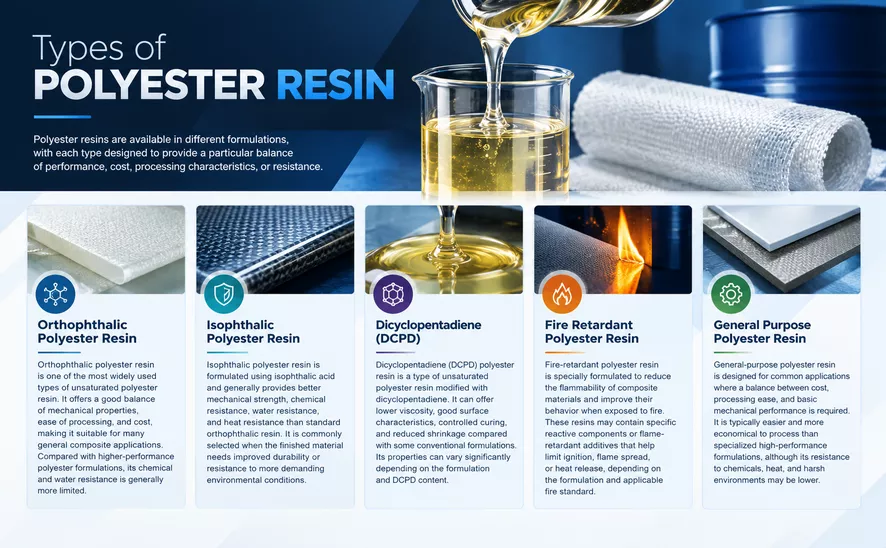
Polyester resins are available in different formulations, with each type designed to provide a particular balance of performance, cost, processing characteristics, or resistance.
Orthophthalic Polyester Resin
Orthophthalic polyester resin is one of the most widely used types of unsaturated polyester resin. It offers a good balance of mechanical properties, ease of processing, and cost, making it suitable for many general composite applications. Compared with higher-performance polyester formulations, its chemical and water resistance is generally more limited.
Isophthalic Polyester Resin
Isophthalic polyester resin is formulated using isophthalic acid and generally provides better mechanical strength, chemical resistance, water resistance, and heat resistance than standard orthophthalic resin. It is commonly selected when the finished material needs improved durability or resistance to more demanding environmental conditions.
Dicyclopentadiene(DCPD)
Dicyclopentadiene (DCPD) polyester resin is a type of unsaturated polyester resin modified with dicyclopentadiene. It can offer lower viscosity, good surface characteristics, controlled curing, and reduced shrinkage compared with some conventional formulations. Its properties can vary significantly depending on the formulation and DCPD content.
Fire Retardant Polyester Resin
Fire-retardant polyester resin is specially formulated to reduce the flammability of composite materials and improve their behavior when exposed to fire. These resins may contain specific reactive components or flame-retardant additives that help limit ignition, flame spread, or heat release, depending on the formulation and applicable fire standard.
General Purpose Polyester Resin
General-purpose polyester resin is designed for common applications where a balance between cost, processing ease, and basic mechanical performance is required. It is typically easier and more economical to process than specialized high-performance formulations, although its resistance to chemicals, heat, and harsh environments may be lower.
What Is Polyester Resin Used For?
- Fiberglass and FRP Products: Used as a matrix resin to bind fiberglass reinforcement and produce strong, lightweight composite materials.
- Marine and Boat Manufacturing: Used in boat hulls, decks, and other fiberglass components because it can form durable composite structures.
- Automotive Components: Used in various fiberglass-reinforced body panels, covers, and other composite parts.
- Construction Materials: Used in composite panels, roofing components, building elements, and other construction products.
- Pipes and Tanks: Used to manufacture fiberglass-reinforced pipes, storage tanks, and vessels with good mechanical and chemical resistance.
- Artificial Stone and Solid Surfaces: Used as a binder in products such as artificial marble, cultured stone, and other decorative surfaces.
- Industrial Components: Used to manufacture different composite parts and equipment where rigidity, durability, and dimensional stability are required.
How Does Polyester Resin Cure?
Polyester resin cures through a chemical cross-linking reaction that converts the liquid resin into a hard, solid material. In unsaturated polyester resin, the unsaturated bonds in the polyester react with a reactive monomer, usually styrene, to form a three-dimensional polymer network. This process is commonly initiated by adding a catalyst or initiator such as methyl ethyl ketone peroxide.
The curing rate depends on factors such as the amount of catalyst, temperature, resin formulation, and ambient conditions. As curing progresses, the resin gradually becomes more viscous and then hardens. Once fully cured, the resulting thermoset material cannot be melted and returned to its original liquid state.
How long does polyester resin take to cure?
Polyester resin typically becomes touch-dry within 20–60 minutes, but full curing may take 24 hours or longer, depending on the formulation and conditions.
Is polyester resin waterproof?
Cured polyester resin is water-resistant, but its waterproof performance depends on the resin type, curing quality, and application conditions.
what diffrence between Polyester Resin and Epoxy Resin?
Polyester resin and epoxy resin are both thermosetting resins, but they differ in formulation, performance, and typical applications. Polyester resin is generally more economical and cures relatively quickly, while epoxy resin usually provides better adhesion, lower shrinkage, and higher chemical and moisture resistance. Polyester resin is commonly used for fiberglass and general composite applications, whereas epoxy is often selected when stronger bonding and higher overall performance are required.
| Polyester Resin vs Epoxy Resin | ||
|---|---|---|
| Property | Polyester Resin | Epoxy Resin |
| Resin Type | Thermosetting resin | Thermosetting resin |
| Adhesion | Moderate | Excellent |
| Chemical Resistance | Good, depending on formulation | Generally very good |
| Water Resistance | Good, depending on formulation | Generally better |
| Curing | Usually initiated with MEKP | Usually cured with a hardener |
| Shrinkage | Higher | Lower |
| Processing | Generally easy to process | Requires controlled resin-to-hardener mixing |
| Cost | Generally lower | Generally higher |
| Common Uses | Fiberglass and general composite products | Structural bonding, coatings, and high-performance composites |
Is polyester resin stronger than epoxy?
Generally, epoxy offers better adhesion and often higher mechanical performance, but the actual strength depends on the formulation and application.
Polyester Resin vs Other Plastics and Resins
Compared with polyethylene and polypropylene, polyester resin is mainly chosen when a rigid, reinforced, and durable material is needed, while PE and PP are thermoplastics that are valued for flexibility, lightweight properties, and easy processing. Polyester resin is often used in applications where structural strength and dimensional stability are important, whereas PE and PP are more common in everyday plastic products, packaging, containers, and molded components.
On the other hand Compared with gum rosin, polyester resin has a different role in material production. Gum rosin is often used as a natural resin component or modifier to improve properties such as tackiness and adhesion in formulations, while polyester resin is typically used as a structural binder in composite materials. Their functions are different, with gum rosin focusing more on adhesive and formulation properties, and polyester resin providing strength and rigidity to finished materials.
| Polyester Resin vs PE vs PP vs Gum Rosin | ||||
|---|---|---|---|---|
| Property | Polyester Resin | Polyethylene (PE) | Polypropylene (PP) | Gum Rosin |
| Material Type | Thermosetting resin | Thermoplastic polymer | Thermoplastic polymer | Natural resin |
| Thermal Behavior | Cannot be remelted after curing | Can be melted and reshaped multiple times | Can be melted and reshaped multiple times | Softens when heated |
| Main Characteristics | High rigidity, good strength, dimensional stability | Flexibility, lightweight, impact resistance | Low density, good chemical resistance, toughness | Tackiness, adhesion, and natural resin properties |
| Typical Applications | Fiberglass composites, FRP products, coatings, industrial parts | Packaging, containers, films, pipes, household products | Food containers, automotive parts, textiles, consumer products | Adhesives, coatings, inks, and resin modification |
| Processing Method | Curing through chemical cross-linking | Melting and molding processes | Melting and molding processes | Blending, heating, and formulation processes |
| Structural Strength | High, especially when reinforced with fibers | Moderate, depending on grade | Moderate to good, depending on grade | Low structural strength |
| Role in Products | Provides a rigid matrix and binds reinforcement materials | Provides plastic structure and flexibility | Provides lightweight and durable plastic components | Improves adhesion and formulation properties |
Is polyester resin thermoplastic or thermosetting?
Polyester resin, particularly unsaturated polyester resin, is thermosetting. Once cured, it cannot be melted and reshaped.
How to Use Polyester Resin
- Prepare the Surface: Ensure the surface is clean, dry, and free of dust or grease.
- Mix the Resin: Add the recommended amount of MEKP catalyst according to the manufacturer’s instructions.
- Apply the Resin: Use a brush, roller, or suitable application method to spread the resin evenly.
- Allow It to Cure: Let the resin harden under the recommended temperature and curing conditions.
- Finish the Surface: Once fully cured, sand or trim the material if necessary.
Safety tip: Work in a well-ventilated area and wear appropriate gloves and eye protection. Follow the product’s safety data sheet
How to Choose Polyester Resin
Choosing the right polyester resin depends on the intended application, required mechanical strength, chemical and water resistance, curing time, and working conditions. Orthophthalic resin is generally suitable for cost-effective, general-purpose applications, while isophthalic resin is often preferred when better water resistance and durability are needed. Before purchasing, check the resin grade, viscosity, compatibility with reinforcing materials, curing requirements, and the manufacturer’s technical data sheet to ensure it meets your project specifications.
Purchase Polyester Resin
Purchasing polyester resin requires choosing a suitable formulation based on the intended application, curing system, processing conditions, and required performance. Buyers should consider factors such as resin type, viscosity, curing requirements, chemical and water resistance, packaging, order quantity, destination, and delivery terms. Working with an experienced supplier can also help ensure that the selected polyester resin meets both the technical specifications and commercial requirements of the application.
Polyester Resin Price
The price of polyester resin depends on the type and formulation of the resin as well as market conditions and purchasing requirements. Different grades, raw materials, manufacturers, order volumes, packaging options, and delivery destinations can all affect the final price. For this reason, requesting a current quotation based on the required resin type, quantity, and destination is the most reliable way to determine the actual purchase cost.
What Affects Polyester Resin Price?
- Resin Type: Orthophthalic, isophthalic, DCPD, fire-retardant, and other polyester resin formulations can have different prices based on their performance and composition.
- Resin Specification: Properties such as viscosity, reactivity, curing characteristics, and chemical resistance can influence product selection and pricing.
- Raw Material Costs: Changes in the prices of glycols, acids, anhydrides, styrene, and other petrochemical raw materials can affect polyester resin costs.
- Order Quantity: Larger commercial quantities may allow for more competitive pricing depending on the supplier and purchasing arrangement.
- Manufacturer and Origin: The producer, country of origin, technical specifications, and availability of a particular resin grade can influence its market price.
- Packaging: Drums, IBC tanks, or other packaging formats may result in different overall costs depending on the order requirements.
- Market Conditions: Supply availability, production costs, regional demand, and broader petrochemical market conditions can cause polyester resin prices to change.
- Shipping and Delivery Terms: Freight costs, destination, Incoterms, insurance, and delivery arrangements can have a significant effect on the final landed cost.
Looking for a reliable polyester resin supplier? Chemical Trading Company supplies polyester resin to customers in international markets. Contact our sales team with your required resin type, quantity, and destination to receive a current quotation.
Proforma Invoice for Polyester Resin
When purchasing polyester resin internationally, buyers may request a proforma invoice before confirming the order. This preliminary commercial document generally includes key information such as the resin type and specification, quantity, packaging, unit price, payment terms, delivery conditions, and other transaction details. It gives the buyer an opportunity to review the proposed terms and can also be useful for banking, import, and customs procedures.

If you need a proforma invoice for Polyester Resin, Nowfel FZC can prepare the required commercial documentation based on your purchasing requirements. By providing information such as the required resin grade, quantity, destination, and preferred delivery terms, you can receive a quotation and proforma invoice prepared for your order.
Why Choose Us as Your Polyester Resin Supplier?
- Different Polyester Resin Grades: We can supply polyester resin options for different applications, processing methods, and performance requirements.
- Application-Based Product Selection: Our team can assist in identifying a suitable resin based on factors such as curing system, viscosity, mechanical requirements, and end use.
- International Supply: We support polyester resin procurement for customers across different markets and destinations.
- Flexible Order Quantities: Supply arrangements can be discussed according to the buyer’s required volume and purchasing requirements.
- Commercial Documentation: We can provide quotations, proforma invoices, and other necessary commercial information for international transactions.
- Responsive Sales Support: Our team assists buyers throughout the purchasing process, from product selection and quotation to delivery arrangements.
- Competitive Commercial Terms: We provide polyester resin options based on current market conditions, product specifications, quantity, and destination.
For more information or to purchase Polyester Resin, feel free to contact us by email. Our sales and support team will be happy to assist with your product requirements, quotation, and delivery arrangements.
disadvantage
Everything discussed so far from the applications and benefits of polyester resin to its specific characteristics has focused primarily on the material’s strengths. However, polyester resin also has some limitations that should be considered before use. It generally exhibits higher shrinkage during curing than epoxy resin, can produce a noticeable styrene odor, and typically offers lower adhesion and chemical resistance compared to epoxy or vinyl ester systems.
Another drawback is that cured polyester resin can be relatively brittle; consequently, reinforcement such as fiberglass may be required when greater mechanical strength is needed. Its performance also depends heavily on the resin formulation, curing conditions, and catalyst ratio. Therefore, selecting the appropriate grade and adhering to the manufacturer’s technical instructions are crucial for achieving consistent results.