
Nowfel Insights
Know Your Incoterms 2026


What Are Incoterms?
Incoterms(International Commercial Terms) are standardized trade terms published by the ICC to define the responsibilities, costs, and risks of buyers and sellers in international transactions. They clarify key aspects of a shipment, including transportation, delivery, insurance, customs clearance, and the point at which risk transfers from the seller to the buyer.
Incoterms provide a common framework for international sales contracts, helping buyers and sellers clearly understand who is responsible for each stage of the shipment and reducing misunderstandings in cross-border trade.
Why Are Incoterms Important in International Trade?
Incoterms make international transactions clearer by defining the responsibilities, costs, and risks of buyers and sellers. They help reduce disputes and misunderstandings by establishing who handles transportation, customs procedures, insurance, and delivery at different stages of the shipment.
How Do Incoterms Work?
Incoterms work by assigning specific responsibilities to the buyer and seller for delivery, transportation costs, customs procedures, insurance, and risk. The selected Incoterm is usually included in the sales contract together with a named place or destination, such as FOB Shanghai Port or DAP Dubai.
What Are the Latest Incoterms?
You may have seen terms such as Incoterms 2026, Incoterms 2027 or Incoterms 2020 online. In many cases, references to future versions such as 2026 or 2027 are the result of misunderstanding or unofficial usage, because the latest official edition is Incoterms® 2020, published by the International Chamber of Commerce(ICC) and effective from January 1, 2020.
ICC first introduced Incoterms in 1936 and has revised them periodically to reflect changes in international trade, with major editions released in 1953, 1967, 1976, 1980, 1990, 2000, 2010, and 2020. As of now, Incoterms® 2020 remains the current official version.
How Often Are Incoterms Updated?
Incoterms do not follow a fixed update schedule. The ICC typically reviews and revises them periodically to reflect changes in international trade and transportation practices.
Incoterms 2020 vs. Incoterms 2010
Incoterms® 2020 introduced several changes to improve clarity and address practical issues in international trade. Key updates include changes to FCA, CIP, DAT, DPU, and security-related requirements, as well as clearer explanations of costs and responsibilities.
| Feature | Incoterms 2010 | Incoterms 2020 |
|---|---|---|
| Number of rules | 11 | 11 |
| DAT | Delivered at Terminal (DAT) | Replaced by DPU (Delivered at Place Unloaded) |
| FCA | Standard FCA provisions | Allows an option for an on-board bill of lading |
| CIP insurance | Lower default insurance coverage | Higher default insurance coverage |
| Security requirements | Less detailed | More clearly addressed |
| Cost responsibilities | Less detailed presentation | Costs are presented more clearly |
what are the 11 incoterms?
The 11 Incoterms® 2020 rules are divided into four categories based on the level of responsibility assumed by the seller:
- E-Term: EXW — Ex Works
- F-Terms: FCA, FAS, FOB — The seller delivers the goods to a carrier or a location specified by the buyer.
- C-Terms: CPT, CIP, CFR, CIF — The seller pays for the main carriage, but risk transfers earlier.
- D-Terms: DAP, DPU, DDP — The seller takes responsibility for delivering the goods to the destination.

EXW (Ex Works)
EXW is short for Ex Works. Under this rule, the seller makes the goods available at their premises, while the buyer handles transportation, export clearance, import clearance, and most other shipping arrangements. for example:
A chemical supplier sells 20 tons of a chemical under EXW Dubai Warehouse. The seller makes the goods available at the warehouse, while the buyer arranges pickup, transportation, export and import clearance, and insurance. Risk transfers to the buyer when the goods are made available at the agreed location.
FCA (Free Carrier)
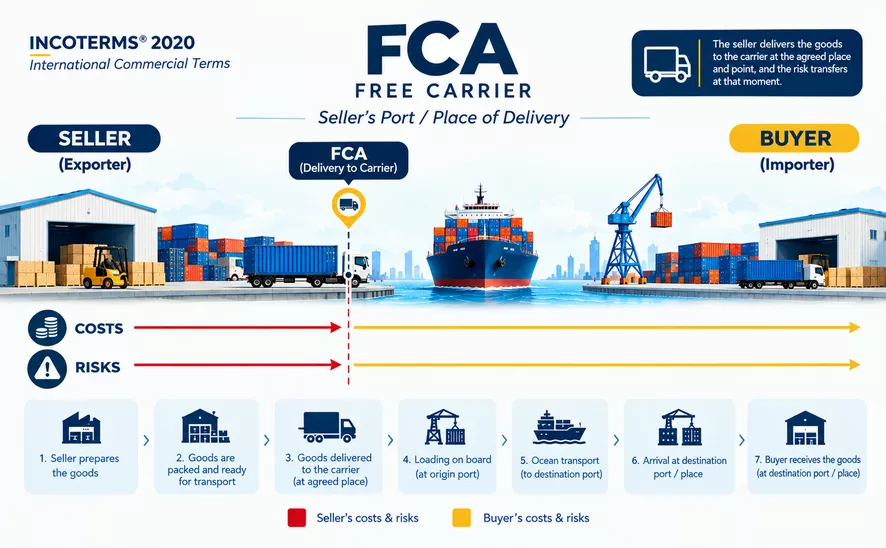
The seller delivers the goods to the carrier or another agreed location under FCA, short for Free Carrier. The buyer then takes responsibility for the main transportation and subsequent costs and risks.
FAS (Free Alongside Ship)
The seller delivers the goods alongside the vessel at the named port of shipment under FAS, or Free Alongside Ship. The buyer is responsible for loading the goods onto the vessel and subsequent transportation.
FOB (Free on Board)
FOB means Free on Board. The seller delivers the goods on board the vessel at the named port of shipment, and risk transfers to the buyer once the goods are loaded on board.

Example of an FOB Transaction a supplier sells a container of chemicals under FOB Jebel Ali Port. The seller handles export clearance and delivers the goods on board the vessel at the agreed port. The buyer arranges the main sea transportation and insurance, and the risk transfers when the goods are loaded on board the vessel.
CPT(Carriage Paid To)
The seller pays for transportation to the named destination under CPT, which means Carriage Paid To, but the risk transfers to the buyer when the goods are handed over to the carrier.
CIP (Carriage and Insurance Paid To)
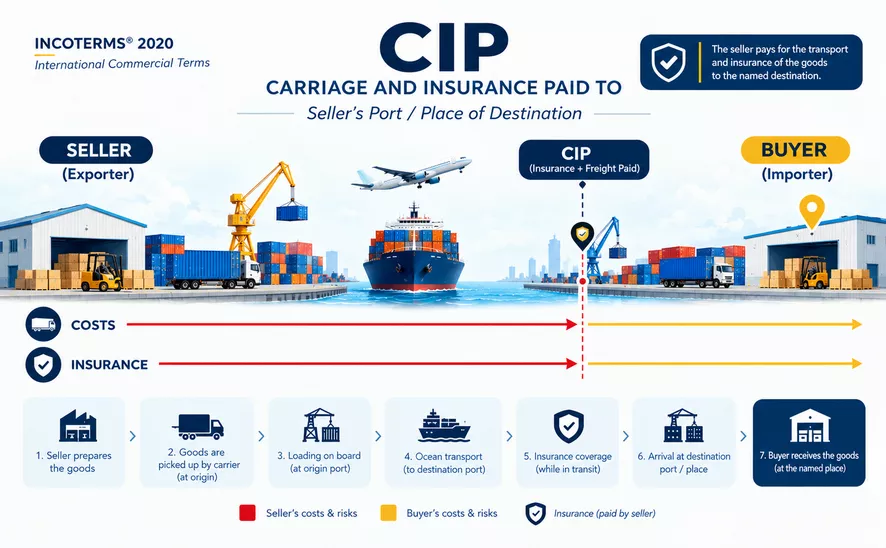
CIP means Carriage and Insurance Paid To. The seller pays for transportation to the named destination and also arranges the required insurance coverage for the goods during transport.
CFR (Cost and Freight)
The seller pays the cost and freight to the destination port under CFR, which stands for Cost and Freight. Risk transfers to the buyer once the goods are loaded on board the vessel.
CIF (Cost, Insurance and Freight)
The seller pays the cost and freight to the destination port and arranges insurance under CIF or Cost Insurance and Freight. This rule applies to the main sea or inland waterway transport.
for example a chemical supplier sells a bulk shipment under CIF Shanghai Port. The seller arranges export clearance, ocean freight, and the required insurance to the named destination port. However, risk transfers to the buyer when the goods are loaded on board the vessel at the port of shipment.
DAP (Delivered at Place)
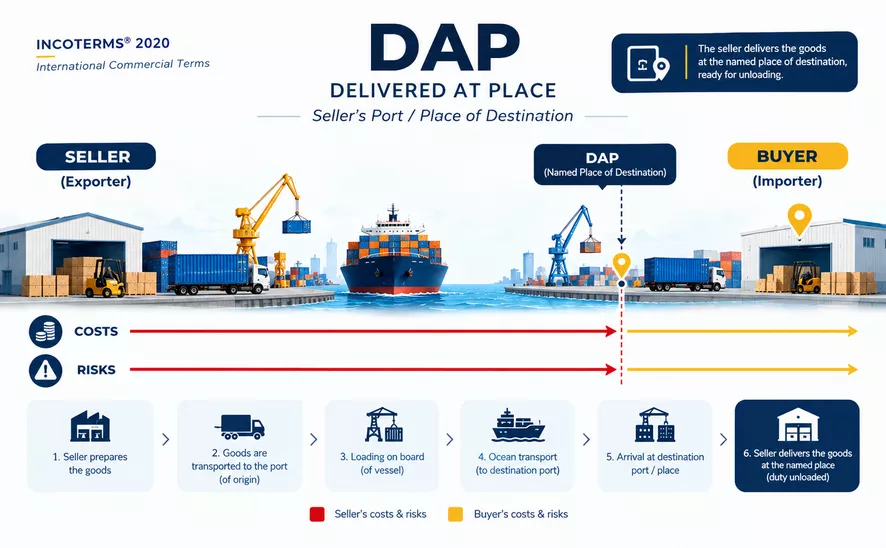
Under DAP, or Delivered at Place, the seller delivers the goods to the named destination, ready for unloading. The buyer is generally responsible for import clearance, duties, and taxes.
DPU Delivered at Place Unloaded
The seller is responsible for delivering and unloading the goods at the named destination under DPU, meaning Delivered at Place Unloaded. The buyer handles import clearance, duties, and taxes.
DPU vs. DAT
DPU(Delivered at Place Unloaded) replaced DAT (Delivered at Terminal) in Incoterms® 2020. The main difference is that DAT required delivery and unloading at a terminal, while DPU expanded this concept by allowing the goods to be delivered and unloaded at any agreed place, not just a terminal. In both rules, the seller is responsible for transportation and unloading up to the named destination, while the buyer generally handles import clearance, duties, and taxes.
DDP (Delivered Duty Paid)
DDP is short for Delivered Duty Paid. The seller assumes most of the delivery responsibilities, including transportation, export and import clearance, duties, taxes, and delivery to the agreed destination.

Example of a DDP Transaction a chemical supplier sells goods under DDP Dubai, UAE. The seller arranges transportation, export and import clearance, and pays the applicable import duties and taxes until the goods reach the agreed destination, ready for unloading. The buyer generally takes responsibility for unloading.
Incoterms by Transportation Mode
| Incoterm | Road | Rail | Air | Sea | Inland Waterway | Multimodal |
|---|---|---|---|---|---|---|
| EXW | ✓ | ✓ | ✓ | ✓ | ✓ | ✓ |
| FCA | ✓ | ✓ | ✓ | ✓ | ✓ | ✓ |
| CPT | ✓ | ✓ | ✓ | ✓ | ✓ | ✓ |
| CIP | ✓ | ✓ | ✓ | ✓ | ✓ | ✓ |
| DAP | ✓ | ✓ | ✓ | ✓ | ✓ | ✓ |
| DPU | ✓ | ✓ | ✓ | ✓ | ✓ | ✓ |
| DDP | ✓ | ✓ | ✓ | ✓ | ✓ | ✓ |
| FAS | ✗ | ✗ | ✗ | ✓ | ✓ | ✗ |
| FOB | ✗ | ✗ | ✗ | ✓ | ✓ | ✗ |
| CFR | ✗ | ✗ | ✗ | ✓ | ✓ | ✗ |
| CIF | ✗ | ✗ | ✗ | ✓ | ✓ | ✗ |
Incoterms Responsibilities: Buyer vs. Seller
As previously mentioned, Incoterms define the responsibilities, costs, and risks borne by the seller and the buyer during international transport. The precise allocation depends on the applicable law.
The image below summarizes the main responsibilities of the buyer and seller under the 11 Incoterms 2020 rules.

Important: Transportation cost and risk transfer are not necessarily at the same point. For example, under CFR and CIF, the seller pays the freight to the destination port, but the risk transfers to the buyer when the goods are loaded on board the vessel at the port of shipment.
Incoterms and Transfer of Risk
The transfer of risk is one of the most important aspects of Incoterms. It determines when the buyer becomes responsible for loss or damage to the goods during transportation. This point can occur before the seller has completed paying for transportation, as seen with CPT, CIP, CFR, and CIF.
For international chemical shipments, identifying the exact risk-transfer point is particularly important because the value of the cargo, transportation distance, and handling requirements can significantly affect potential losses.
Incoterms and Insurance
Under Incoterms 2020, only CIP and CIF specifically require the seller to arrange cargo insurance. Under CIP, the seller must obtain a higher level of insurance coverage, while CIF generally requires the minimum level of coverage specified by the rules. The other Incoterms do not require the seller to arrange insurance, so the buyer should consider whether additional cargo insurance is appropriate.
| Feature | CIF | CIP |
|---|---|---|
| Full name | Cost, Insurance and Freight | Carriage and Insurance Paid To |
| Insurance arranged by | Seller | Seller |
| Insurance required | Yes | Yes |
| Default insurance level | Minimum coverage | Higher coverage |
| Transport mode | Sea and inland waterway | Any mode of transport |
| Risk transfers | When goods are loaded on board the vessel | When goods are handed over to the carrier |
When Should Buyers Purchase Additional Insurance?
Buyers should consider additional insurance when the coverage required under the selected Incoterm does not adequately protect the value or risks of the shipment. This can be particularly relevant for high-value chemical cargo, long-distance transportation, multimodal shipments, or goods that require special handling.
Even when the seller provides insurance under CIF or CIP, buyers should review the policy conditions, coverage limits, exclusions, and deductible before deciding whether additional coverage is needed.
Incoterms for International Chemical Trade
Choosing the right Incoterm is especially important in international chemical trade because chemical shipments may involve bulk transportation, containers, hazardous materials, specialized handling, and strict documentation requirements. For chemical shipments, buyers and sellers should consider the transport mode, delivery point, transportation costs, insurance, customs clearance, and the exact point where risk transfers. FCA, CPT, and CIP can be suitable for containerized or multimodal shipments, while FOB, CFR, and CIF are specifically used for sea and inland waterway transport. For bulk chemical imports, the selected Incoterm should also match the type of cargo, loading facilities, port arrangements, and transportation method.
For hazardous chemicals, Incoterms define commercial responsibilities but do not replace applicable safety, transport, packaging, labeling, or regulatory requirements. The parties should clearly agree on responsibilities for export and import documentation, dangerous-goods declarations, safety data sheets packaging, labeling, permits, inspections, and other regulatory requirements. These responsibilities should be clearly stated in the sales contract because an Incoterm alone does not determine every packaging, documentation, or regulatory obligation associated with a chemical shipment.
How to Choose the Right Incoterm
When choosing an Incoterm, consider the following practical factors:
- Transport Mode: Choose an Incoterm that matches the transportation method. For example, FOB, CFR, and CIF are intended for sea and inland waterway transport, while FCA, CPT, and CIP can be used for any mode of transport.
- Cost Responsibility: Determine which party should arrange and pay for transportation, loading, unloading, and other delivery costs.
- Risk Transfer: Identify the exact point where the risk of loss or damage transfers from the seller to the buyer.
- Insurance: Consider whether insurance is required. CIF and CIP require the seller to arrange insurance, while other Incoterms generally do not.
- Customs Clearance: Decide who will handle export and import clearance, duties, and taxes. This is particularly important when using DDP, where the seller takes on extensive import responsibilities.
- Delivery Location: Clearly define the named place, port, or destination in the contract to avoid confusion about where delivery and risk transfer occur.
- Type of Goods: For chemical shipments, consider whether the cargo is bulk, containerized, hazardous, or subject to special handling and regulatory requirements.
- Buyer and Seller Capabilities: Select an Incoterm that matches each party’s ability to arrange transportation, customs procedures, insurance, and delivery in the relevant country.
Common Mistakes When Using Incoterms
Common Incoterms mistakes include choosing a rule that does not match the transportation method, failing to specify the exact named place or port, and assuming that the party paying for transportation is automatically responsible for the risk. Buyers and sellers should also avoid using outdated terms such as DAT, which was replaced by DPU in Incoterms 2020. Another common mistake is assuming that every Incoterm includes insurance or that the seller is always responsible for import customs clearance and taxes.
To avoid disputes, the sales contract should clearly state the selected Incoterm, named location, applicable Incoterms version, and responsibilities for transportation, customs clearance, insurance, loading, and unloading. For chemical shipments, it is also important to separately confirm requirements for hazardous-goods documentation, packaging, labeling, permits, and regulatory compliance, as these obligations are not fully determined by the Incoterm itself.
Incoterms vs. Other Trade Terms
Incoterms define the delivery responsibilities, costs, and risk allocation between buyers and sellers, but they do not cover every aspect of an international sales transaction. Payment terms, shipping terms, letters of credit, and contracts of sale address different parts of the transaction and may work alongside Incoterms. Understanding these differences helps buyers and sellers avoid confusing delivery obligations with payment, financing, or contractual requirements.
| Term | What It Defines | Examples | Relationship to Incoterms |
|---|---|---|---|
| Incoterms | Delivery, costs, responsibilities, and transfer of risk | EXW, FOB, CIF, DAP, DDP | Defines delivery-related obligations |
| Payment Terms | When, how, and under what conditions the buyer pays | Advance Payment, Open Account, Cash Against Documents | Separate from delivery responsibilities |
| Shipping Terms | Arrangements and conditions related to transportation and shipment | Freight Prepaid, Freight Collect | May complement an Incoterm but does not replace it |
| Letters of Credit | Bank-supported payment mechanism and required documents | Documentary Letter of Credit, Irrevocable L/C | Can be used together with an Incoterm |
| Contracts of Sale | Overall rights, obligations, specifications, and conditions of the sale | International Sales Contract | Incoterms can be incorporated into the sales contract |
NOWFEL intercomes
Navigating the complexities of chemical logistics can be challenging. Whether you need advice on selecting the right Incoterm for your specific cargo—from bulk petrochemicals to containerized additives—or require support with hazardous materials documentation, our team at Nowfel is here to assist. Contact us for a consultation on your next shipment.
Frequently Asked Questions
refrence: https://iccwbo.org/business-solutions/incoterms-rules/incoterms-2020/