
Nowfel Insights
PE vs PP: How to Choose the Right Plastic?


Polyethylene(PE) and polypropylene(PP) are two of the most widely used thermoplastic polymers, serving a broad range of applications from packaging and consumer products to industrial components. Although both materials belong to the polyolefin family and share several characteristics, their molecular structures and performance properties give them distinct advantages in different applications.
One of the main differences between PE and PP is their response to heat and mechanical stress. Polypropylene generally offers greater rigidity and a higher melting temperature, while polyethylene is available in a wider range of grades, including materials known for excellent flexibility, toughness, and impact resistance. Both polymers also provide good chemical and moisture resistance, making them suitable for many demanding environments.
In this article from the Nowfel Chemical Company series, we compare PE and PP in terms of properties, performance, applications, advantages, and limitations to help you determine which is better suited to your needs.
What Is Polyethylene?
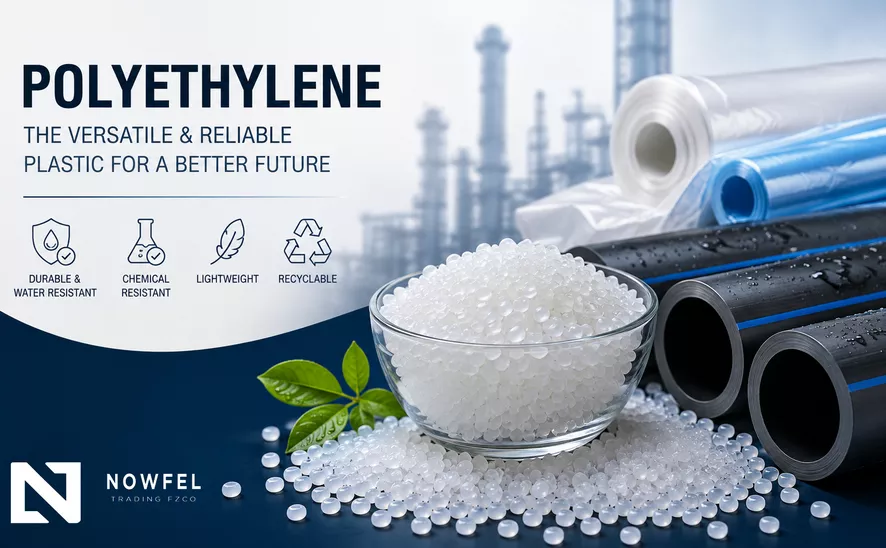
Polyethylene(PE) is a thermoplastic polymer that belongs to the polyolefin family. It is produced mainly from ethylene and is one of the most widely used plastics due to its versatility, durability, and resistance to moisture and chemicals. Depending on the type and grade, polyethylene can be processed using methods such as extrusion, injection molding, and blow molding.
It is commonly used to make plastic bags, packaging films, bottles, containers, pipes, toys, and many other everyday and industrial products. For more detailed information, please refer to our articles on What Is Polyethylene?
Types of Polyethylene
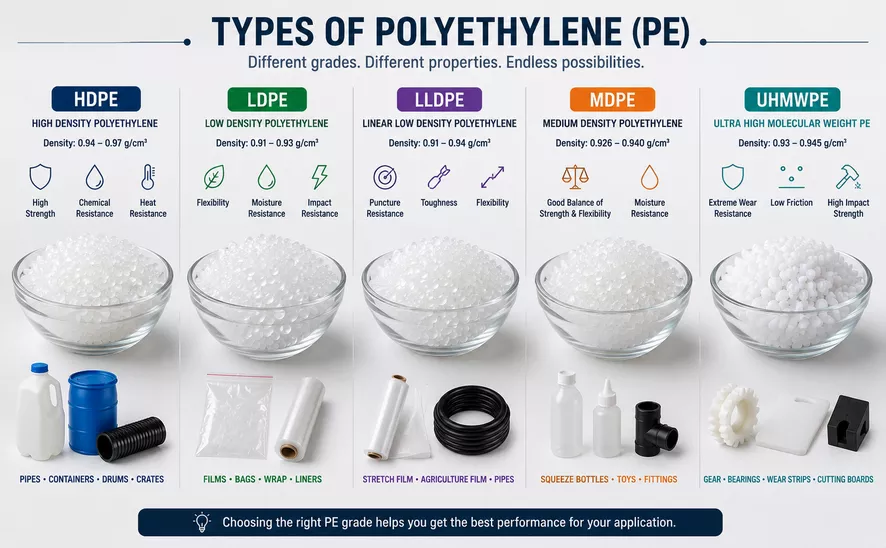
- LDPE: A flexible and relatively soft type of PE, commonly used for plastic bags, films, packaging, and squeeze bottles.
- LLDPE : A flexible PE with good tensile and impact strength, widely used for stretch films, packaging films, and liners.
- HDPE: A stronger and more rigid type of PE with excellent chemical resistance, commonly used for pipes, bottles, tanks, containers, and industrial products.
- MDPE: A PE grade with properties between LDPE and HDPE, offering a balance of flexibility, strength, and impact resistance. It is often used for pipes, fittings, and protective packaging.
Besides these four common types, polyethylene is also available in specialized forms such as Ultra-High Molecular Weight Polyethylene(UHMWPE) and Cross-Linked Polyethylene(PEX). These materials are developed for more specific applications and have modified properties compared with conventional PE grades. UHMWPE is known for its exceptional wear resistance and high molecular weight, while PEX has a cross-linked structure that provides improved temperature resistance and mechanical strength.
What Is Polypropylene?
Polypropylene(PP) is a thermoplastic polymer that belongs to the polyolefin family. It is produced from propylene and is known for its low density, good chemical resistance, and ability to withstand relatively high temperatures. Polypropylene can be processed using methods such as injection molding, extrusion, and blow molding, making it suitable for a wide range of products.
It’s commonly used in food containers, packaging, automotive parts, fibers, ropes, household products, and industrial components. If you would like to learn more about Polypropylene, you can read our detailed article What Is Polypropylene? here.
Types of Polypropylene
- PP Homopolymer (PP-H): Made from propylene as the only monomer. It offers good stiffness, strength, and chemical resistance and is widely used in rigid products, containers, and packaging.
- PP Random Copolymer (PP-R): Produced by polymerizing propylene with a small amount of another monomer, usually ethylene. It provides better flexibility, clarity, and impact resistance than homopolymer PP and is commonly used in packaging and piping.
- PP Impact Copolymer: Contains a rubber phase that improves toughness and impact resistance, particularly at lower temperatures. It is widely used for automotive parts, containers, and durable plastic products.
Other specialized forms of polypropylene are also available for specific applications. These include PP Block Copolymer, which is designed to provide a balance of stiffness and impact resistance, PP Terpolymer, which can offer specific combinations of flexibility, clarity, and sealing properties, and Expanded Polypropylene(EPP), a lightweight foam used for energy absorption and protective applications.

differences between PE and PP
PE and PP share many useful properties, but they differ in areas such as flexibility, stiffness, heat resistance, and impact performance. The table below provides a quick comparison of their key properties and typical applications.
| PE vs PP: Key Differences | ||
|---|---|---|
| Property | PE | PP |
| Flexibility | Higher in many grades | Generally more rigid |
| Density | Lower to moderate | Low |
| Chemical Resistance | Excellent | Excellent |
| Heat Resistance | Lower | Higher |
| Impact Resistance | Excellent | Good to excellent |
| Moisture Resistance | Excellent | Excellent |
| Stiffness | Depends on grade | Generally higher |
| Typical Applications | Packaging, pipes, containers | Automotive, packaging, household products |
Which One Is Better for Packaging?
When it comes to packaging, the choice between PE and PP depends largely on the required flexibility, barrier properties, temperature resistance, and end use. PE generally offers greater flexibility and excellent moisture resistance, making it suitable for plastic bags, films, liners, and flexible packaging.
PP is usually more rigid and provides better heat resistance, which makes it a good choice for food containers, microwaveable packaging, and applications where the package needs to maintain its shape at higher temperatures. Both materials provide good moisture barriers, while their resistance to gases and other substances can vary depending on the specific grade and packaging structure.
Both PE and PP are widely used in food-contact applications, provided that the selected grade meets the relevant food-contact requirements. From a cost perspective, both are relatively economical commodity plastics, but the final price depends on the grade, processing method, and market conditions.
In general, PE is often preferred for flexible and cost-sensitive packaging, while PP can offer advantages when greater stiffness, heat resistance, or repeated use is required.
Which One Is Better for Industrial Applications?
Both PE and PP are widely used in industrial applications, but each has advantages depending on the operating conditions. PE is commonly used for pipes, chemical containers, tanks, liners, and other products where impact resistance, flexibility, and chemical resistance are important. HDPE, in particular, is widely used for industrial pipes and tanks because of its toughness and resistance to many chemicals.
PP generally offers higher temperature resistance and greater stiffness, making it suitable for chemical-processing equipment, containers, tanks, and components exposed to elevated temperatures. For automotive components and industrial parts, PP is often selected when low weight, rigidity, dimensional stability, and heat resistance are important.
PE can be a better option when the application requires greater impact resistance, flexibility, or resistance to harsh outdoor conditions. The final choice should therefore consider factors such as chemical exposure, operating temperature, mechanical loads, impact requirements, and the specific grade of polymer.

Recyclability and Sustainability
Both polypropylene and polyethylene are recyclable thermoplastics and can be collected, processed, and reused in a range of applications. However, their recyclability and environmental performance depend on factors such as the polymer grade, product design, collection systems, and recycling technology. PE includes several widely recycled grades, particularly HDPE and LDPE, while PP recycling is also becoming more common as collection and processing infrastructure improves.
Among PE grades, HDPE is generally considered a highly recyclable material and is widely recovered from products such as bottles, containers, pipes, and other rigid packaging. However, it would be inaccurate to determine overall sustainability based only on how many times a material can theoretically be recycled. The environmental impact of PE and PP also depends on factors such as material efficiency, product lifespan, energy consumption, and the availability of effective recycling systems.
PE vs PP: How to Choose the Right Plastic?
The right choice between PE and PP depends on the performance requirements of the final product. Choose PE if you need
- higher flexibility
- excellent impact resistance
- pipes or flexible packaging
- strong performance at low temperatures
PE is particularly suitable for applications where toughness and flexibility are more important than high-temperature performance.
Choose PP if you need
- higher operating temperatures
- greater stiffness
- repeated flexing or automotive rigid packaging applications
PP is generally better suited to products that need to maintain their shape under heat or withstand repeated mechanical movement.
By comparing these properties with the actual conditions of use, you can select the PE or PP grade that best fits your application.
| PE vs PP: Quick Comparison Table | |
|---|---|
| Factor | Better Choice |
| Flexibility | PE |
| Heat Resistance | PP |
| Chemical Resistance | Both |
| Impact Resistance | PE |
| Stiffness | PP |
| Moisture Resistance | Both |
| Low-Temperature Performance | PE |
| Repeated Flexing | PP |
| Rigid Packaging | PP |
| Flexible Packaging | PE |
Alternative Materials to Polypropylene and Polyethylene
Depending on the application, several other materials can be considered as alternatives to PP & PE:
- Polyvinyl Chloride: Offers good chemical resistance, durability, and weather resistance. It is widely used in pipes, construction products, cables, and industrial applications.
- Polyethylene Terephthalate: Known for its strength, clarity, and good barrier properties. It is commonly used for bottles, food packaging, and polyester fibers.
- Acrylonitrile Butadiene Styrene(ABS): Provides good impact resistance, rigidity, and surface quality. It is often used for automotive parts, electronic housings, and consumer products.
- Polystyrene: A lightweight and economical plastic available in rigid and foam forms. It is used in packaging, disposable products, and insulation.
- Polycarbonate: Offers high impact strength, transparency, and good heat resistance. It is suitable for safety equipment, automotive components, and engineering applications.
- Nylon(Polyamide): Provides high mechanical strength, wear resistance, and good temperature performance. It is commonly used for gears, bearings, automotive components, and industrial parts.
Conclusion
The choice between PE vs PP depends on the specific application and required properties. PE is generally better for flexibility and impact resistance, while PP offers greater stiffness and heat resistance.